Pretentheism: Devotion without Dogma
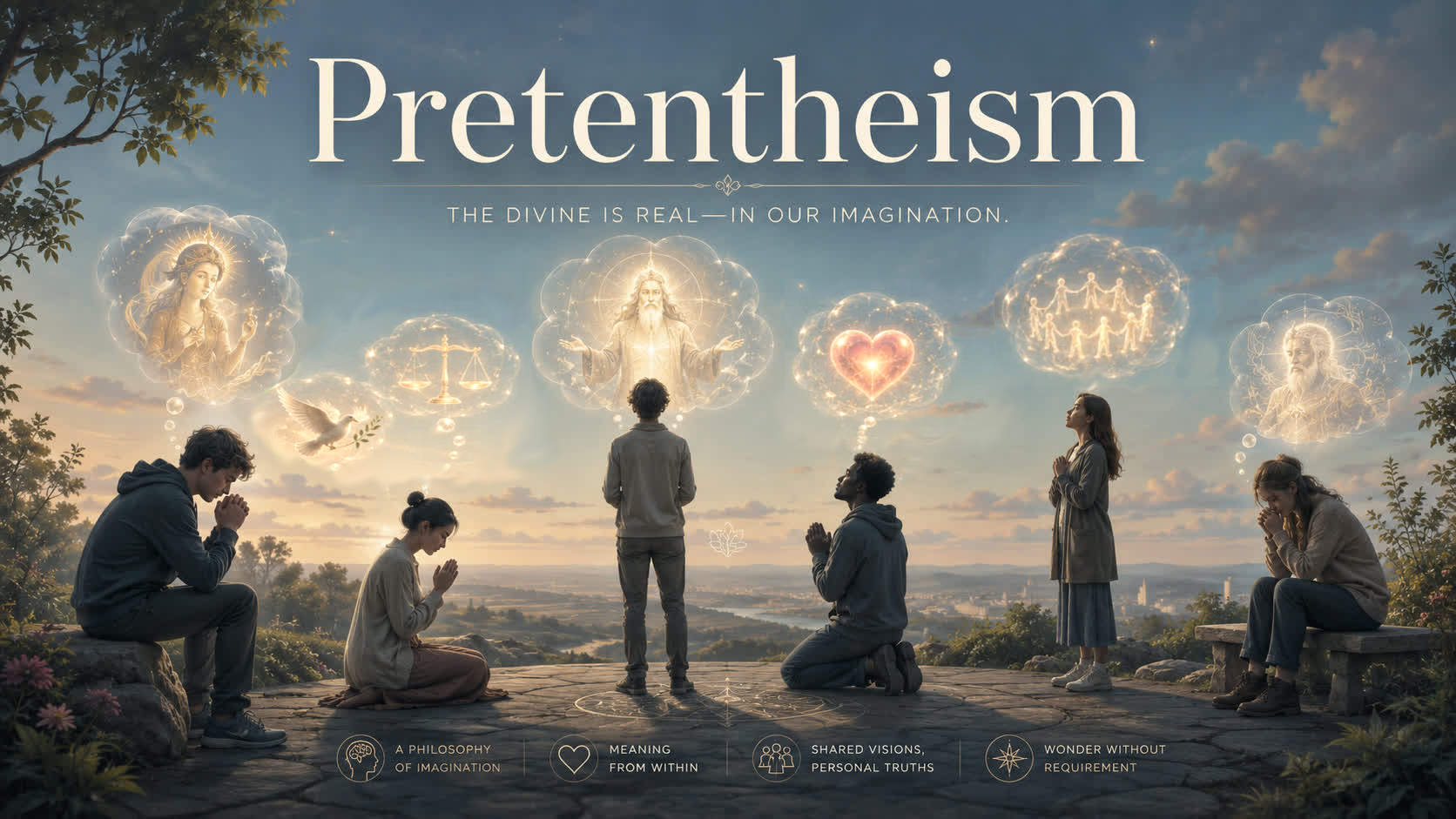
The philosophy of Pretentheism
Pretentheism is the disciplined, honest, imaginative practice of living as though goodness, beauty, and love were woven into the fabric of reality, without claiming certainty that this is metaphysically true.
I do not believe in God as a literal metaphysical being, but I will imaginatively inhabit a divine-centered worldview because it can cultivate reverence, humility, gratitude, moral seriousness, and joy.
Divinity is not a fact I affirm, but a sacred fiction I use to orient the mind and to live a graceful existence.
The divine does not consist of a human-like deity looking over the world. Instead, the divine is an ethical lodestar that orients us towards cooperation, joy, and peace.
I do not believe God exists, but I sometimes live as though the universe were worthy of gratitude, reverence, and moral accountability.
It is close to religious fictionalism, spiritual pragmatism, or as-if religion.There are precedents. Pascal’s wager says one should behave as if one believes, partly because practice may produce faith. William James argued that some beliefs are live options whose value cannot be assessed from detached evidence alone. Hans Vaihinger wrote about the “philosophy of as if”: humans often use fictions that are not literally true but are practically fruitful. Buddhism, too, often treats doctrines and practices as “skillful means” rather than propositions to be believed in the same way one believes in atoms or tax law.
The danger is that “pretentheism” can become kitsch, self-deception, or moral laziness: “I’ll pretend God loves me, therefore all is well.” Worse, it can become a way to borrow the emotional consolations of religion while ducking its demands. But that danger is not fatal. Art, myth, theater, ritual, music, poetry, and even political ideals all involve deliberate imaginative participation in something not literally present.
A doctor of theology told me that in his opinion most doctors of theology are atheists. One can still live a grace-filled existence without believing in God or other myths. Buddhism is an example of a religion — or maybe it's a philosophy — that promotes ethical living and transcendence without emphasizing deities and associated otherworldly creeds.
© 2026 Donald A. Smith. I independently arrived at the term “pretentheism” in 2020. This site develops my own formulation of the idea. Comments and suggestions welcome: thinkerfeeler@gmail.com